
Decoding Dholera's DNA
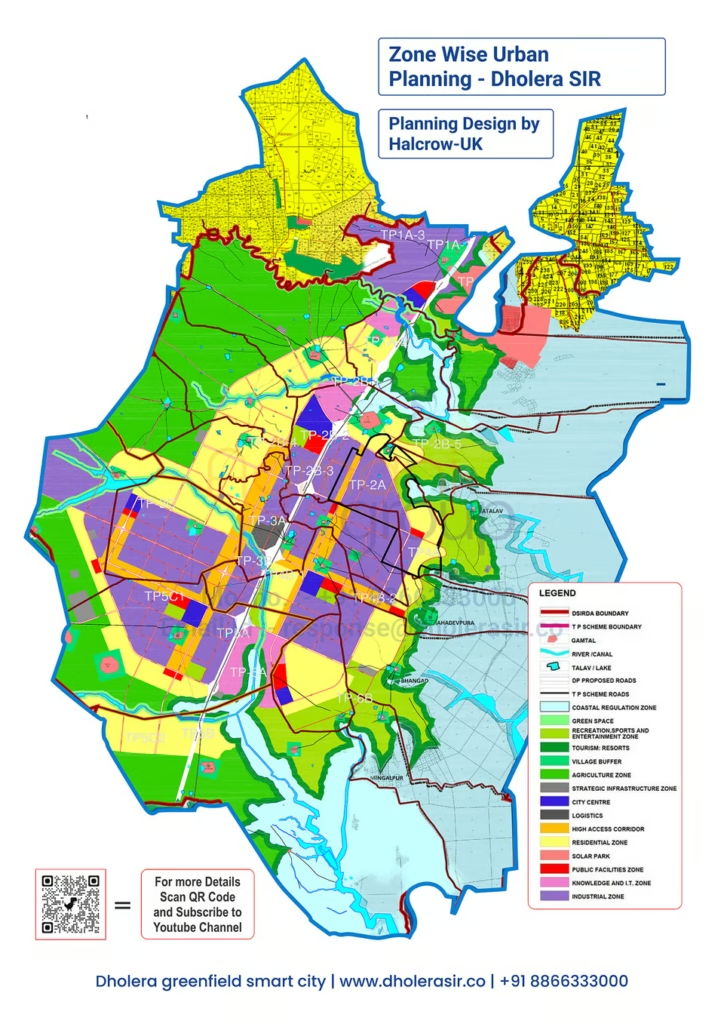
To understand Dholera, you must first understand its skeleton. Unlike old cities that grew organically (and often chaotically), Dholera is being built on a strict, pre-designed grid known as Town Planning (TP) Schemes. Think of these schemes as giant “Lego blocks” of development. The entire 920 sq. km region is divided into these blocks, each with a specific theme, deadline, and purpose.
Here is the clear, jargon-free breakdown of the four major blocks you need to know about.
1. The TP Breakdown: Choosing Your Zone
TP 1: The “Face” of the City (Residential & Civic Core)
- The Vibe: This is designed to be the “Manhattan” or the downtown of Dholera. It covers about 51 sq. km.
- What goes here: It is heavily focused on Residential housing (for the workforce) and Civic amenities. It sits right next to the original Dholera village. This is where the major government buildings, the initial housing societies, and the commercial high-streets are planned.
- For the Investor: This is the “safe” bet for residential growth because it is closest to the existing population centers.
TP 2: The “Engine” of the City (Industrial & Mixed Use)
- The Vibe: This is the workhorse. It is the largest scheme (approx. 102 sq. km) and arguably the most important one right now.
- What goes here: It contains a mix of everything—industries, logistics parks, and residential pockets for workers. Most importantly, it houses the Activation Area (more on that below).
- For the Investor: This is the “Growth” zone. If you want to be near the factories (Tata Electronics, ReNew Power), you look here.
TP 3 & TP 4: The “Future” Expansion
- The Vibe: These are the next frontiers.
- TP 3 connects the city to the coastal zone and focuses on industries that might need proximity to the future port or renewable energy parks.
- TP 4 is gaining massive attention recently because it is located near the International Airport. It is shaping up to be a logistics and hospitality hub.
- For the Investor: These are “Long-term” plays. The infrastructure here is not as developed as TP1 or TP2 yet, so land prices are lower, offering higher potential appreciation for those willing to wait 10+ years.
2. The “Activation Area”: The Focal Point
You will hear this term constantly. The Activation Area is a 22.5 sq. km zone located inside TP2.
Why is everyone talking about it? Imagine you are building a house, but you want to see a “Model Room” first to believe the builder. The Activation Area is Dholera’s “Model Room”—but on a massive scale.
- It is READY: While other areas are still having roads built, the Activation Area is “Plug-and-Play.” The roads (up to 70m wide), underground sewers, gas pipelines, electric cables, and giant ICT (internet) ducts are already laid and operational.
- No Digging Required: Because of the smart planning, you will never see a road being dug up to fix a pipe here. All utilities run in dedicated underground tunnels.
- First Movers Advantage: This is where the first big companies (Anchor Tenants) are building their factories right now because they can literally plug into the power and water tomorrow.
Summary for the Investor:
- TP 1 & TP 2 (Activation Area): “Ready” or “Near Ready.” Higher entry price, lower risk, faster development.
- TP 3 & TP 4: “Planning/Early Stage.” Lower entry price, higher risk, longer wait time (but potentially higher multiplier).